
Skip to content
  • Home
  • AHSA
    • AHSA Inc. Meetings
    • AHSA Inc
      • AGM 2022
    • AHSA (NSW) Inc.
    • AHSA (QLD) Inc.
    • Privacy Policy
    • Disclaimer
  • Publications
    • Aviation Heritage
    • Aviation Heritage Web Archive
    • AHSA Newsletter Archive
  • Members
    • Members Only
  • Books
  • Join
  • Links
  • Store
  • Log In
    • My Membership Account
Aviation Historical Society of Australia
  • Home
  • AHSA
    • AHSA Inc. Meetings
    • AHSA Inc
      • AGM 2022
    • AHSA (NSW) Inc.
    • AHSA (QLD) Inc.
    • Privacy Policy
    • Disclaimer
  • Publications
    • Aviation Heritage
    • Aviation Heritage Web Archive
    • AHSA Newsletter Archive
  • Members
    • Members Only
  • Books
  • Join
  • Links
  • Store
  • Log In
    • My Membership Account

March 2021 Outlook Newsletter

DerekB29/03/202107/10/2021
thumbnail of AHSA_Newsletter_v37_n2_2021-03

The March 2021 edition of Outlook AHSA News has been emailed to members.

A copy can also be downloaded from the Newsletter archive here on the website. Click on the link below to open this edition:
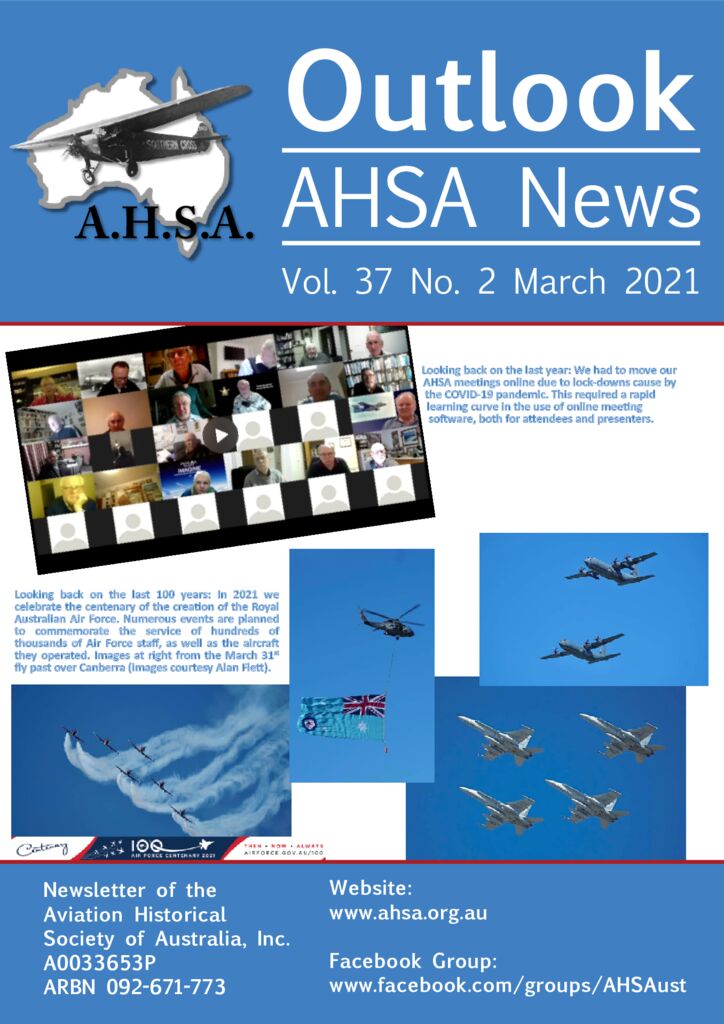
Outlook AHSA Newsletter Volume 37 Number 2 March 2021

  • Twitter
  • Facebook
  • Google+
  • Linkedin
  • Email
Posted inNewsletter

Welcome to the website of the Aviation Historical Society of Australia Inc.
The AHSA is dedicated to recording and promoting Australian aviation history. We find and tell the stories of how aviation (both civil and military) has contributed to the development of Australia and the experiences of Australian people.
To navigate around the site, select from the menu bar above, click on one of the updates below or choose one of the categories below.

On this day in Australian aviation history:

1991 Piper PA-28-161 VH-XCB crashed at Mt McKeahnie, ACT on 24 February 1991. The aircraft was operating on a pleasure flight in a mountainous area. The aircraft had been flown to the area at 6000 ft and was planned to operate below 5000 ft for 20 min before returning to Canberra. The aircraft was observed flying at low level following the floor of a valley. After completing a pass in a northerly direction, the aircraft continued tracking north-west to climb over a range. While over rising terrain, the aircraft struck a tree, the impact tearing the right wing from the airframe. The right wing remained lodged in the tree approximately 27 m above the ground while the aircraft descended through the trees and impacted the ground, on its right side, approximately 35 m beyond the first tree impact. The aircraft was destroyed by fire and the four occupants received fatal injuries. Examination of the wreckage at the accident site and a subsequent strip examination of the engine did not reveal any technical defects that would have caused the accident. Examination of the propeller indicated that it was rotating as the aircraft descended through the trees but was stationary at the time of impact with the forest floor. Onsite examination of the engine revealed the throttle in the closed position and the mixture selected to 'Idle Cutoff'. However, damage to the right wing was consistent with a high speed impact, indicating that the aircraft possessed the necessary kinetic energy to maintain terrain clearance. The flap lever was found in the fully retracted position, a further indication that the initial impact with the tree was unexpected and did not result from the pilot attempting a forced landing in the treetops. Whether the initial impact was the result of the pilot misjudging his clearance from the treetops or from an attempted manoeuvre that was unsuccessful due to aircraft inertia cannot be determined. Sources: ATSB and aviation-safety.net websites
1991 A Lufthansa Boeing 747-400, D-ABTC, mistook Essendon airport runway 35 for Melbourne Airport and almost landed at the wrong airport and on a much shorter runway. The weather in the Melbourne area was clear, with good visibility. Melbourne Airport runway 34 was in use and visual approaches were required. The aircraft, which was approaching Melbourne Airport from the west, was radar vectored onto base leg and descended to 3000 feet. At 1704 hours Melbourne Approach Control advised the crew that their position was nine miles south-west of the field. They were asked to advise when they had the runway in sight and also to say when the runway 34 lead in strobe lights were sighted. Shortly after, the crew responded that they had the runway and strobe lights in sight. Approach Control gave the crew their position as six miles south-west of the field, told them to make a visual approach and not to descend below one thousand five hundred feet until established on final. At 1706 hours the controller told the crew they were approaching the runway extended centre line. The Approach Controller noted that the aircraft was passing through the extended centre line and had not turned to line up with runway 34. He promptly issued instructions to the aircraft to climb to 2000 feet. At about the same stage the crew realised that the runway they had been looking at was too short for their operations and also decided to go around. Further radar vectors were given and the aircraft subsequently landed normally on runway 34 at Melbourne Airport without any other problems. Runway 35 at Essendon Airport was the runway sighted by the pilots. It does not have lead in strobe lights. The crew indicated they must have seen reflections near Essendon which they mistook for strobe lights. On the approach the crew had seen a runway from a long way out, which they thought was the north/south runway for Melbourne Airport, but was in fact runway 35 at Essendon Airport. In the lighting conditions at the time they did not see Melbourne Airport, until on the go around. Runway 34 at Melbourne does not have an instrument approach procedure. However, the 165 radial from the Melbourne VHF Omni Range (VOR) radio aid at Melbourne Airport can be used to give an indication of the extended centre line for runway 34. Distance information from Melbourne was also available from the Melbourne International Distance Measuring Equipment. On the approach the minimum height descended to was just over 1000 feet above the elevation of Essendon Airport. Source: ATSB website
2011 Aero Commander 500S Shrike Commander VH-WZU operated by Flightech Pty Ltd crashed at 26 km NNW off Horn Island, Queensland on 24 February 2011. At 0445 Eastern Standard Time, the pilot commenced a freight charter flight from Cairns to Horn Island under instrument flight rules. The aircraft arrived in the Horn Island area at about 0720 and the pilot advised air traffic control that he intended holding east of the island due to low cloud and rain. At about 0750 he advised pilots in the area that he was north of Horn Island and was intending to commence a visual approach. When the aircraft did not arrive a search was commenced but the pilot and aircraft were not found. On about 10 October 2011, the wreckage was located on the seabed about 26 km north-north-west of Horn Island. The ATSB found that the aircraft had not broken up in flight and that it impacted the water at a relatively low speed and a near wings-level attitude, consistent with it being under control at impact. It is likely that the pilot encountered rain and reduced visibility when manoeuvring to commence a visual approach. However, there was insufficient evidence available to determine why the aircraft impacted the water. Sources: ATSB and aviation-safety.net websites

Ansett Flying Boat Services Ballarat Beaufighter Bellanca 28/70 Bill Bedford Boeing Brinsmead Bronco CAC CAC Boomerang CAC Ceres CAC Mustang CAC Wackett Trainer CAC Wirraway CAC Woomera Chartair Cyclone Tracy DAP DC-3 DCA DH.50 DH60 Moth Duigan Memorial Lecture Eric Bonar Essington Lewis Eyre Peninsula Airways GAF Guinea Airways Halestorm JC Fitzmaurice Junkers F13 Lawrence Wackett Macchi Meteor Michael Smith Outlook Percival Proctor Qantas RAF 205 Squadron RFD Winged Target Roy Goon Sid Marshall Smithy (movie) Supermarine Southampton Target towing

Site Categories:

  • AHSA Info
  • AHSA Journal
  • AHSA Meetings
  • AHSA Videos
  • Archives
  • Aviation history books
  • CAC
  • Events
  • Newsletter

Privacy Policy

Contact Us

Home

Copyright © 2025 Aviation Historical Society of Australia Inc.